


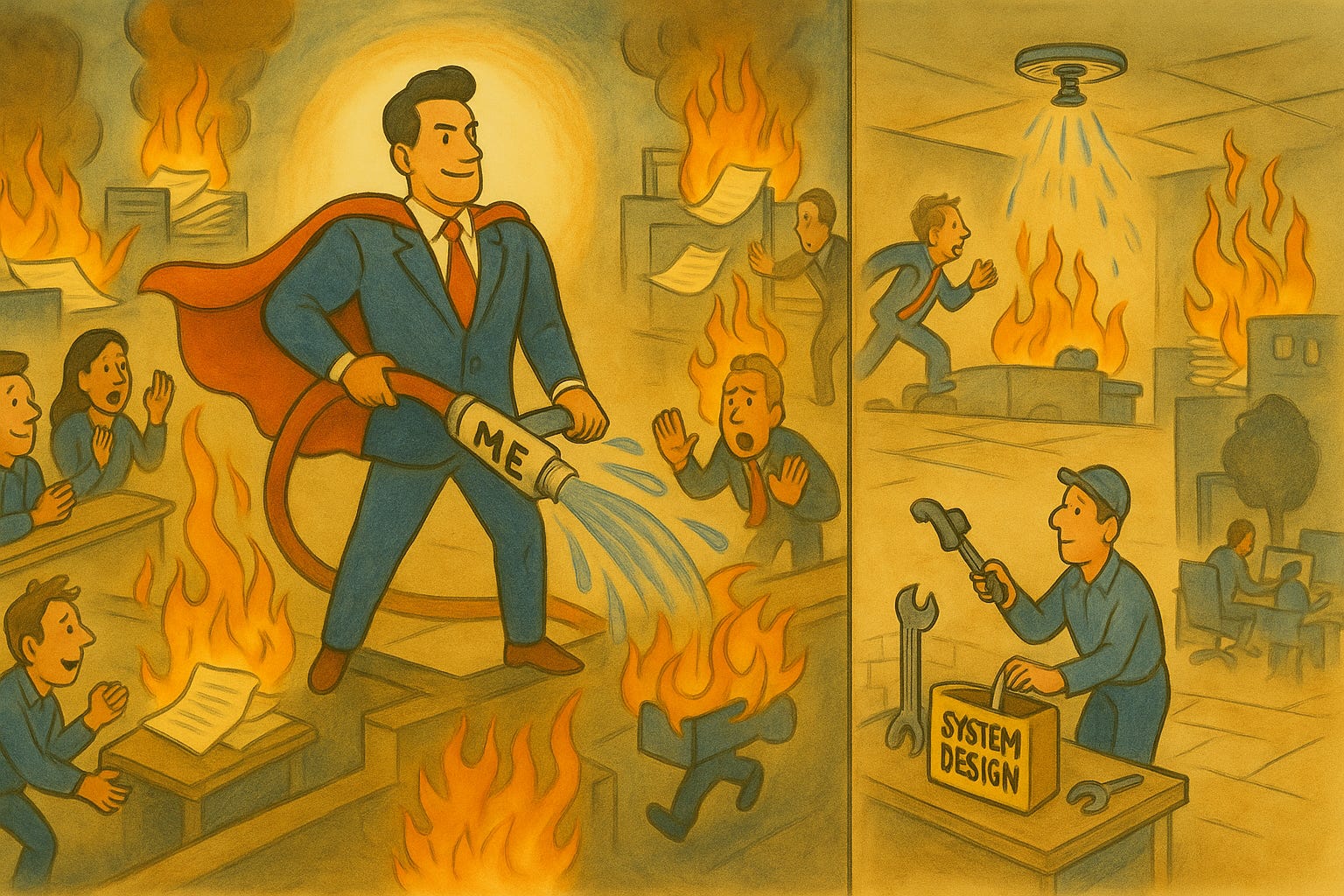
The Lure of the Firefighter
There’s a certain seduction to being the fixer.
You know the role: The project is off the rails, people are whispering in Slack threads, deadlines are haemorrhaging, and someone says:
“Get [insert your name] in here.”
You walk into chaos like it’s your natural habitat, crack your knuckles, draw up a war room, and three weeks later the thing limps across the finish line with a smile and a band-aid. Applause all around. Hero status secured.
And while that rush is real, the dopamine hit of crisis management, the praise, the perceived indispensability, it’s also a trap.
Because here’s the inconvenient truth no one wants to admit in the afterglow of a “save”: Most of those fires? Preventable.
We glorify the firefighter but neglect the fire marshal. The leaders who quietly build systems that don’t catch fire in the first place? They don’t get medals. They get peace of mind, and stronger businesses.
So, what if our leadership metric wasn’t how dramatically we save the day, but how little drama we have to save?
What if we celebrated the invisible skill of prevention as much as the visible feat of fixing?
The Shift: From Reactive Brilliance to Proactive Maturity
The modern business environment is too fast, too layered, and too exposed to risk for leaders to rely on reactivity as a strategy. Being brilliant under pressure might get you through today, but it won’t build a company that lasts through tomorrow.
That’s why this article flips the script.
We’re stepping out of the chaos and into the design lab, where systems, structures, and habits are engineered to reduce the very need for heroics.
Not to remove agility, but to replace whack-a-mole leadership with intentional, resilient architecture.
We’ll explore:
Why messes start (hint: they rarely show up overnight).
What systems and processes act like immune systems for your business.
Which leadership habits prevent dysfunction before it starts.
Because the most future-fit organizations aren’t the ones that fix the most messes.
They’re the ones that don’t let the mess happen in the first place.
Deconstructing the "Mess": Where Chaos Actually Begins
Let’s bust a myth up front: Most business messes aren’t born in an explosion. They don’t come crashing in like a thunderstorm. They creep.
They start quietly. Invisibly. Death by 10,000 tiny misalignments.
And by the time people start using words like “fire drill,” “restructure,” or “escalate to leadership,” the damage has been compounding for months, if not longer.
The Boiling Frog Problem
You know the parable: Drop a frog into boiling water, and it’ll leap out. Place it in cool water and slowly raise the heat? It’ll stay put, until it’s dinner.
Organizations are full of frogs. Bright, well-intentioned people swimming in systems that are heating up with complexity, contradictions, and unspoken resentment… until something breaks. Then we act shocked.
But if we want to prevent the mess, we have to understand where it starts.
1. Cumulative Drift
This is the slow rot. A dashboard goes unreviewed. A handoff gets a little sloppier each month. A team inherits a broken process and learns to work around it instead of fixing it. Before you know it, you have five tools doing the same thing and no one really knows which one’s the source of truth.
These aren’t explosive errors. They’re subtle. Tolerated. Institutionalized.
And they pile up until the system groans.
Prevention Principle: Every ignored inefficiency is a future crisis with a longer tail.
2. Information Silos
Everyone’s got data, but no one’s got context. Marketing has the numbers, Finance has the budget, Product has the roadmap, but the dots aren’t connected. So decisions get made on partial truths, and teams end up rowing in different directions.
It’s not incompetence. It’s fragmentation.
And the mess doesn’t just show up in dashboards, it shows up in missed goals, duplicated work, and internal politics disguised as miscommunication.
Prevention Principle: If data doesn’t move, neither will your teams.
3. Ambiguous Accountability
Have you ever seen a task assigned to “Team X”? Translation: no one owns it. Or worse, everyone thinks someone else does. This is how things fall through the cracks, and why “I thought you had it” might be the most expensive phrase in your organization.
Without clear ownership and defined success criteria, accountability becomes a ghost, everyone’s looking for it, no one’s catching it.
Prevention Principle: If ownership isn’t explicit, it’s non-existent.
4. Lack of Feedback Loops
Here's the silent killer: doing the same thing again and again, hoping it won’t explode next time. When teams don’t pause to ask, “What went wrong?” or “What’s changing?” they become really efficient at repeating dysfunction.
No learning, no evolution, just smoother spirals into the same pitfalls.
Prevention Principle: Systems without reflection breed repetition, not progress.

Architecting Order: Building Systems That Prevent the Mess
Here’s the uncomfortable truth most leaders don’t say out loud: We love fixing messes more than preventing them. Firefighting makes us look decisive. Prevention? That’s invisible. Quiet. Unsexy.
But in high-functioning teams, order is not a happy accident. It’s engineered.
Let’s walk through how to actually design for that kind of clarity, before the chaos ever begins.
1. Designing for Clarity & Flow
Concept: Clarity isn't just about documentation, it’s about how decisions, data, and tasks move through your systems.
A well-designed system makes it hard to mess up. There are fewer handoffs, fewer ambiguities, and more automatic signal checks along the way. It doesn’t rely on people being perfect; it supports them when they’re busy, distracted, or new.
System Examples:
Centralized source of truth (ERP, CRM)
Unified workflows (e.g., P2P, O2C that actually talk to each other)
Automation that flags inconsistencies before humans do
Real-World Fix: A mid-sized fintech I advised used to reconcile numbers across five tools manually. Everyone had a slightly different version of “revenue.” After implementing a unified dashboard with locked definitions, disputes disappeared, and so did the three-day lag in reporting.
!!! If your data flows like a game of telephone, your decisions will too.
2. Building Resilient & Adaptive Frameworks
Concept: Great systems aren’t just efficient; they bend without breaking. They adapt when the world changes. (Spoiler: it always does.)
System Elements:
Modular infrastructure (each piece can evolve independently)
AI-driven anomaly detection (flagging weird patterns early)
Flexible operating models (pods, cross-functional teams, embedded finance)
Real-World Fix: One finance team moved from annual budgeting to rolling forecasts. Their AI system flagged a burn-rate spike in Q2 tied to a new vendor’s invoicing pattern, weeks before it would’ve shown up in the monthly close.
!!! Prevention is about seeing weak signals while they’re still small. Resilience doesn’t mean nothing breaks, it means things recover before they cause damage.
3. Instituting Proactive Governance & Controls
Concept: Governance isn’t bureaucracy, it’s prevention with teeth. But only when it’s built into the flow, not bolted on afterward.
System Elements:
Embedded decision rights (clear who can do what)
Automated policy enforcement (e.g., no spend approval = no PO)
Risk-based alerts (real-time exceptions, not just post-mortems)
Real-World Fix: A fast-scaling startup embedded automated risk rules into their procurement tool. Anything above €5K triggered a peer review. This one tiny rule prevented a six-figure compliance penalty.
!!! Don’t just audit after the fact. Embed the guardrails where the work happens.
4. Creating Continuous Feedback Loops
Concept: Every system should have a built-in reflection mechanism. Otherwise, you're just locking in outdated assumptions.
System Elements:
Post-mortems and pre-mortems as standard operations
Feedback prompts inside workflows (e.g., “What slowed you down this sprint?”)
Cross-functional reviews that actually share lessons, not just metrics
Real-World Fix: After a product launch that hit revenue goals but failed to retain users, a cross-department debrief revealed it had been optimized for acquisition, not stickiness. Insights went straight into the next launch plan, preventing the same problem from repeating.
!!! Learning is a system design issue, not just a cultural one.

The Disciplined Leader: Habits for Proactive Order
Systems alone don’t prevent messes, people do. But not through sheer willpower or longer hours. What actually matters? Leadership habits that default to prevention without even needing a crisis to prove their worth.
These are not sexy habits. But they’re powerful. They’re the quiet behaviours that create teams that run smoothly, anticipate problems, and rarely escalate to firefighting mode.
1. The Pre-Mortem Habit
Before launching something new, ask: “How could this go wrong?”
Most leaders do a post-mortem once the damage is done. The smartest ones? They do a pre-mortem, a structured imagination of failure before it happens.
Think of it as foresight training. You de-risk your project before the budget gets burned.
Practical Tip: Before every major initiative, run a 30-minute pre-mortem. Ask your team to list three reasons it could fail, and what early signs might look like.
2. The Deep Listening Habit
What’s not being said… matters more than what’s being said.
Frontline operators often feel the mess coming long before it shows up in dashboards. But they won’t always say it in a meeting. They’ll say it in tone. Or hesitation. Or Slack threads.
Practical Tip: Regularly meet with the people closest to your processes. Ask: “What’s the thing you’re worried about that hasn’t broken yet?”
Bonus: You also build trust. People warn leaders who listen.
3. The Simplify-First Habit
Before adding, subtract.
Every new tool, policy, approval step, or metric increases the complexity surface area, where messes can hide and grow. Simplicity is prevention disguised as minimalism.
Practical Tip: Whenever you're about to add something new to a system, ask: “What can we remove to make this work better?” Make it a rule: no net-new complexity without trade-off analysis.
4. The Accountability-by-Design Habit
If “everyone owns it,” no one owns it.
Most process messes aren’t technical. They’re about who drops the ball when it’s no one’s job. Clarity about ownership is the difference between resilience and entropy.
Practical Tip: For every recurring task, build a RACI map (Responsible, Accountable, Consulted, Informed). Even for things that “should be obvious.” Especially for those.
Beyond Fixing, Toward Flourishing
There’s a reason firefighters get parades and fire preventers don’t.
Crisis feels dramatic. Prevention looks… boring. But if you’re leading an organization, a function, or even just your own calendar, you don’t want drama. You want flow.
Because here’s the truth: the most effective leaders aren’t the ones who swoop in with capes. They’re the ones who quietly build systems and habits so solid that emergencies become rare.
They design processes with clarity baked in.
They empower teams to speak up before the problem hits the fan.
They don't chase messes; they engineer environments where mess struggles to survive.
That’s not passive. That’s mastery.
So where do you begin?
You don’t need a full transformation program to start preventing chaos.
You need one:
process worth simplifying,
team worth listening to,
task worth assigning clearly,
or risk worth mapping before it becomes real.
The shift from firefighter to architect isn’t made in a weekend. It’s made in small, intentional decisions that trade adrenaline for clarity, and drama for design.
What’s one area of your life, your team, or your business where the mess could be prevented, not just fixed?
Start there. One habit. One system. One piece of chaos defused before it ever ignites.
And if you’ve got your own “prevention win” or a ritual that keeps things tidy before they get tangled, I want to hear it. Drop it in the comments or let me help you architect your next fix before it’s needed.
Because the best fix… is the one you never have to make.