


Let’s talk about the quiet absurdity we’ve all normalized: hiring decisions, those multi-million-dollar bets on people, are still being made based on resumes.
Documents written by the candidate.
Reviewed by someone who may spend less time on them than on their morning coffee.
Graded by an algorithm trained on past biases and outdated proxies for talent.
This system persists not because it works, but because it’s familiar. Like using a paper map in a world of GPS, it’s a ritual that feels safe but yields very little clarity. Especially in a labor market where the very idea of a “standard career path” has collapsed.
What’s replacing it? Not another format, but a new philosophy.
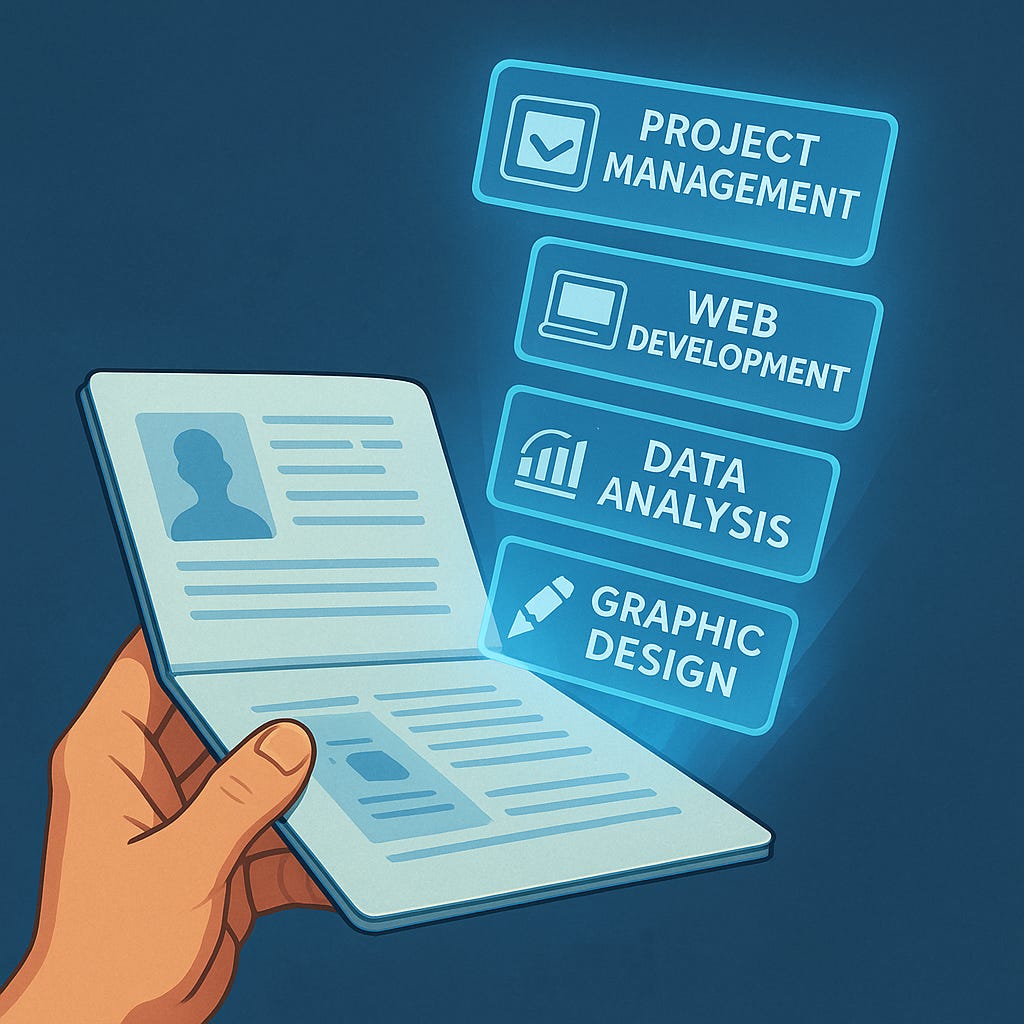
Digital credentials (verifiable, portable, machine-readable proofs of skill) are not just modern badges. They are infrastructure for a new economy of truth. One where learning doesn’t need a degree to be credible. One where skills are not assumed but proven. One where the burden of validation shifts from the employer’s intuition to the system’s architecture.
This isn’t hype. It’s already happening.
Governments are building national skills wallets.
Multinationals are launching credentialing pipelines.
AI tools are consuming verifiable credential data directly into hiring models.
And the shift isn’t just technical, but psychological. It redefines how people build their identity, how organizations define value, and how entire industries recalibrate what counts as “qualified.”
This article is not a how-to. It’s a recalibration. A strategic deep dive into what digital credentials actually are, why they’re the real disruptor behind AI-driven hiring, and how you can either wield this shift, or be quietly outpaced by it.
The Problem with “Proof”
You’ve seen it happen. A high-pedigree hire sails through the interviews. Strategic role. Flashy resume. Prestigious alma mater. Two months later… you realize: you hired confidence, not competence. You trusted the story, not the skill.
The modern resume is a carefully constructed illusion. It tells you who someone thinks they are, not what they can actually do.
In a skills-based economy where everything changes faster than job titles, this is no longer sustainable. The talent market isn’t just inefficient, it’s misaligned. And the cost of that misalignment is rising.
Enter digital credentials. Portable. Verifiable. Owned by the individual. Designed for a world where capability must be proven, not performed.
This isn’t about badges. It’s about building trust into the infrastructure of work itself.
In this next few paragraphs i’ll try to clarify:
What digital credentials actually are
Why they’re disrupting hiring, learning, and leadership
What individuals and companies must do, now, to stay ahead
What Digital Credentials Really Are
Forget everything you think you know about badges and certificates. This isn’t gamified fluff.
A digital credential is a portable, cryptographically signed artifact that proves someone has a specific skill, completed a task, or demonstrated competence in a particular area. Think of it as a verified data packet. But unlike a line on a resume or a LinkedIn endorsement, this one comes with metadata, issuer validation, assessment evidence, and standards you can cross-check.
What makes it powerful isn’t just the credential—it’s the surrounding ecosystem. When you embed a credential into a digital identity wallet, connect it to institutional trust (e.g., a university, employer, or training body), and make it machine-readable, you suddenly have a trust layer for skills that operates at scale.
At their best, they answer five questions:
Who issued it?
What did the person do?
How were they assessed?
When was it earned, and does it expire?
Can this be independently verified?
This is trust, codified.
Unlike resumes or LinkedIn endorsements, credentials can’t be faked. They are:
Verifiable - via blockchain or decentralized signatures
Portable - owned by the user, not trapped in an HR system
Rich in data - capturing evidence, assessments, context
Stackable - build a mosaic of expertise over time
Think of them like an API for your capability. They allow humans and systems to query what you know, and trust that it’s real.
Examples in the wild:
Australia’s National Skills Passport lets workers present verified skills across jobs, industries, and even immigration systems.
EY & Microsoft’s AI Skills Passport is upskilling 1 million professionals with portable, enterprise-ready credentials.
The EU Digital Identity Wallet includes licenses, diplomas, and training records, all tied to your verified ID.
This isn’t hype. It’s infrastructure, and it’s already here.
Why This Is a Silent Earthquake
Digital credentials may not come with a catchy headline, but they carry tectonic force. Here’s why they’re not just useful, but transformative.
The real disruption isn’t the tech. It’s the implications.
1. From Storytelling to Evidence-Based Hiring
The job market has long suffered from credential inflation. A role that used to require a high school diploma now demands a master’s degree, not because the job has changed, but because the signal system is broken. Degrees became a proxy for trust. And proxies are fragile.
Digital credentials bypass this entire inflationary loop. They shift the hiring conversation from "Where did you go?" to "What can you prove?"
That collapses the trust gap. No more “Did they really lead that project?”
Just: verified, timestamped, assessed, done.
The hiring stack shifts from belief to proof. That’s a power shift.
2. The Career Ladder Is Replaced by the Capability Stack
The future of talent isn’t vertical. It’s modular. People move sideways, diagonally, and sometimes through wormholes. The career ladder is now a jungle gym.
As modern careers are non-linear, you may need to combine UX, data fluency, leadership, ethics, and maybe even prompt engineering.
Credentials capture your growth like version history allowing skills to be extracted from legacy job titles and made legible to opportunity systems.
A credentialed project manager in energy can pivot to logistics or climate tech, not because their resume is perfect, but because their skill fingerprint is portable and verified: you’re not “just” a PM anymore. You’re a strategist who understands AI risk, behavioral product design, and regulatory compliance, with verifiable proof.
That’s what gets you hired in 2025.
3. Talent Systems Become Searchable, Not Static
Most AI hiring systems today are stuck filtering keywords. Digital credentials give them something better: a data structure they can trust. This upgrades recruitment from probability-based guesswork to probabilistic matching with real inputs.
Credential-enabled systems let companies:
Map internal skills in real-time
Reduce redundancy and rehire risk
Build smarter L&D pathways
Unlock hidden talent for open roles
Your organisation doesn’t just become more efficient, it becomes more intelligent.
And for professionals? It means you can be seen for what you can do, not just where you’ve been.
4. Trust Becomes Scalable
Trust in hiring is a mess. Candidates embellish. Employers second-guess. Recruiters rely on gut.
Resumes are interpretations. Credentials are verifications.
Credentials provide a shared language of verified truth. You don’t need to “believe” the candidate. You only need to verify the payload.
The bigger your organization, the more this matters. Hiring at scale becomes faster, cheaper, and less biased.
Credentials don’t just save time.
They reduce organizational risk.
They make talent decisions defensible.
The future of hiring won’t ask for a story. It’ll ask for receipts.
4. They Create a Culture of Transparent Growth
Inside companies, credentials allow skill development to be seen. They break learning out of the LMS ghetto and into career narratives.
People get to display growth, not just absorb content.
And when growth is visible, it becomes valuable.
That’s when learning shifts from a compliance exercise to a competitive advantage.
What to Do Now
Let’s get practical.
If You’re a Professional:
Audit your stack: What are your most relevant, verifiable skills?
Earn strategically: Focus on credentials that signal direction, not just completion.
Narrate your learning: Don’t collect badges, sequence them into a story of evolution.
Use public portfolios (Certify.me, Notion, GitHub): Your LinkedIn is just the brochure. Your credentials are the engine.
If You’re an Organisation:
Credential your internal L&D: If you’re already teaching, why not validate it?
Enable credential ingestion: Your ATS and HRIS should read what people have learned, not just store it.
Design mobility maps: Build bridges across functions using skill graphs, not job titles.
Partner wisely: Co-develop credentials with institutions. Control part of the credentialing ecosystem.
This Isn’t Optional Anymore
The labor market is shifting from reputation to verification. From narrative to evidence. From guesswork to clarity.
The digital credential isn’t just a better badge. It’s a signal revolution.
It changes who gets seen, who gets hired, and how we grow. It makes talent legible. It makes learning portable. And it puts proof, not promise, at the center of progress.
In 2025 and beyond, career advantage won’t go to the loudest voice or the fanciest brand. It’ll go to the person who can prove, in verifiable detail, that they’re ready for what’s next.
If you want to lead, hire, grow, or transition in the next decade, your success won’t be built on what you say. It will be built on what you can prove that you can do.
So ask yourself:
When someone scans your profile... will they find a pitch or a passport?
(A pitch is fine, but if supported by a skills/potential for value added passport, it’s even better.)
If this resonated, here are three next steps:
Comment: What’s one credential you wish you had on your passport?
Subscribe: For future articles on future-proof careers, smart systems, and the real signals of success.
Share: If you know someone navigating a career pivot or building L&D systems, this could be a game-changer for them.