


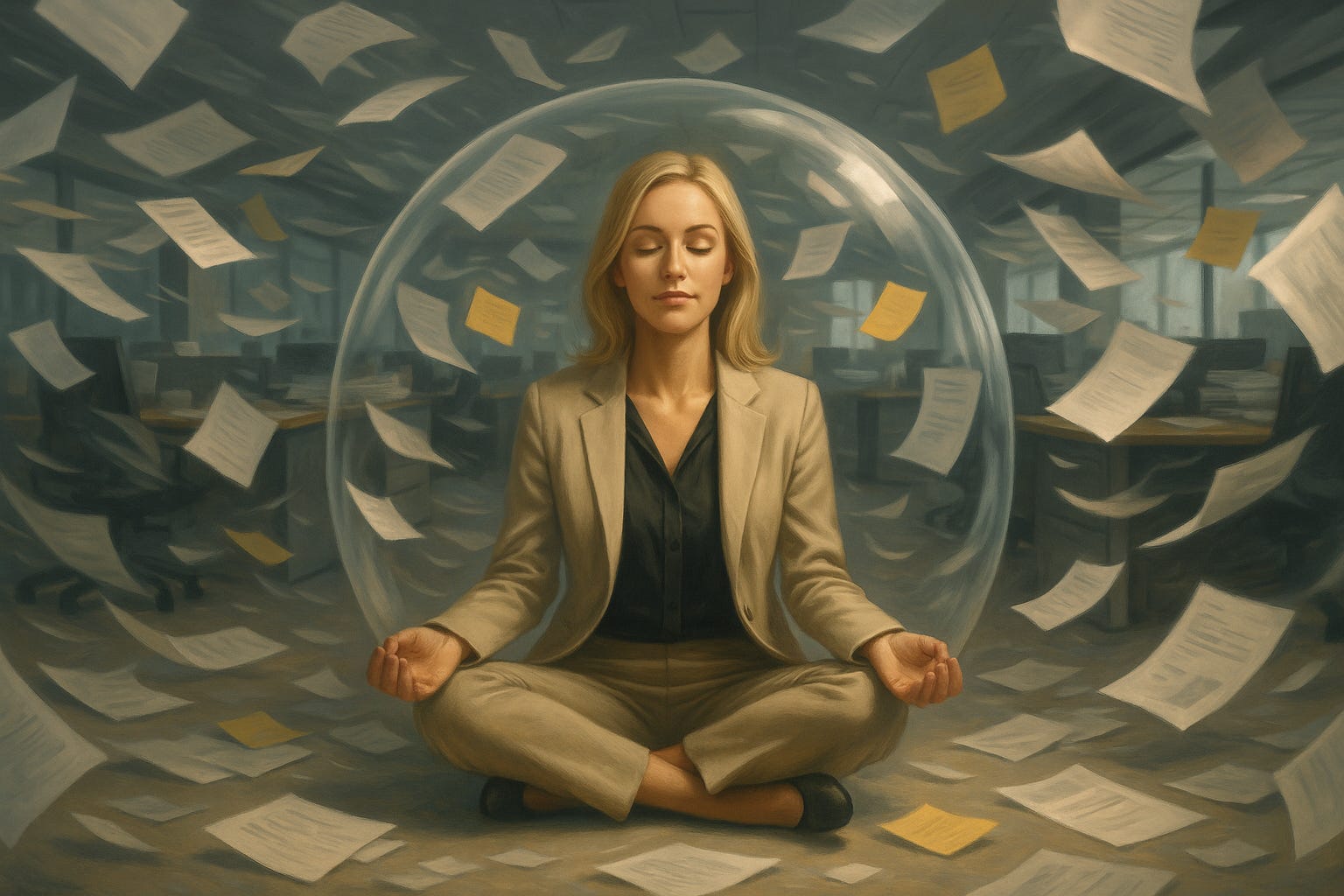
Let me guess: Your calendar looks like a game of Tetris played by someone having a breakdown. Your inbox has mutated into a second job.
Your brain toggles between four tabs, five priorities, and the quiet dread that you’ve forgotten something important, but can’t remember what.
And if someone asks you how you’re doing?
You answer like a seasoned professional: “Busy. But good. Just a lot right now.”
Of course it is. You’re high-functioning. You’re smart. You’re ambitious.
You built a life with options, complexity, opportunity.
And it’s exhausting you.
Here’s the quiet truth I had to admit to myself:
I wasn’t burned out because I was doing too little.
I was burned out because I was doing too much of the wrong stuff, in systems that made it harder than it needed to be.
There wasn’t one big fire to put out.
There were a thousand small leaks, all draining energy invisibly.
My “personal mess” wasn’t chaos. It was clutter with credentials, disguised as ambition, commitment, or worse: identity.
So I did what I do in my work life, I fixed it.
I applied the same clarity lens I use in broken teams and tangled organizations to my own systems:
– My digital spaces
– My time
– My habits
– My attention
Not perfectly. But sustainably.
I untangled the mess not to optimize my life, but to finally enjoy it again.
This article is for anyone quietly overwhelmed but still “keeping it together.”
We’re going to look at the internal clutter behind the external busyness, and how to clear it in ways that actually hold.
I’ll walk you through:
How to diagnose your personal overwhelm like a strategist
My favorite simplification tactics (and what I ditched)
The mindset shift that made it all stick
Because fixing your life isn’t about buying another planner or color-coding your to-do list.
It’s about redesigning your systems so your energy flows where it matters most.
Diagnosing the Overwhelm
Here’s what no one tells you about being “high capacity”:
Your calendar can be full.
Your browser can be loaded.
Your days can be productive.
And your life can still feel like a beautifully curated mess.
Because what we call “overwhelm” isn’t always about volume.
It’s about friction, the invisible drag between your intentions and your actual energy.
You can’t fix what you can’t see.
So let’s map the mess.
1. Identify Your Energy Thieves (Not Just Time Wasters)
Time is easy to spot.
Energy is sneakier.
I started noticing that I could spend two hours doing something I “should” be doing, and feel absolutely drained.
Meanwhile, something that took 20 minutes could light me up for the rest of the day.
So I made a list:
– What tasks leave me foggy?
– What interactions consistently deplete me?
– Where do I overcommit out of guilt or default?
Then I layered in the invisible stuff:
– Obligations I never questioned
– Notifications I forgot I allowed
– Half-finished things that haunted my focus like digital ghosts
That’s when it hit me: I wasn’t running out of time.
I was hemorrhaging cognitive bandwidth on things that didn’t move the needle, but still demanded a toll.
2. Audit the Inputs, Not Just the Outputs
I looked at where my information diet was sabotaging my clarity.
Not just social media, but newsletters, Slack pings, “quick calls,” and that open tab rabbit hole I swore I’d read later (spoiler: I didn’t).
Ask yourself:
– What information are you managing but not actually using?
– What are you subscribed to out of FOMO, not usefulness?
– How many things are you “just checking in on” that should be ignored entirely?
Every input is a demand on your attention.
If you don’t curate them, they’ll curate your focus for you.
3. Find the Pattern Behind Your Personal Disorganization
Clutter isn’t just a physical condition. It’s an emotional one.
Disorganization is often a side effect of avoidance, perfectionism, or decision fatigue in disguise.
For me? It was over-responsibility.
The reason I had three overlapping task systems, half-finished Google Docs, and unread productivity books wasn’t because I didn’t know what to do.
It was because I believed I had to be on top of everything, or I’d fall behind.
Sometimes, disorganization is your nervous system saying:
“I don’t trust that rest is allowed.”
That realization hit harder than any productivity hack ever could.
The System That Stopped Working
A few years ago, I had a board so complex it needed a tutorial... for me.
Color-coded. Filtered. Synced to my Google Calendar and task management tool.
On paper? Genius.
In practice? I spent more time managing the system than doing the work.
The real issue? I was optimizing for control, not clarity.
So I scrapped it.
Rebuilt from scratch.
Now, I run a friction-minimal system that doesn’t punish me for having an off day, it flexes with me.
Diagnostic Takeaway:
If your personal life feels cluttered, start by asking:
– Where does it feel like I’m leaking energy?
– What systems am I maintaining out of guilt, not need?
– What am I pretending is helpful, but secretly resenting?
This isn’t about shaming yourself into “doing better.”
It’s about building awareness without blame.
Because before you can simplify, you have to see the complexity clearly, and admit how much of it is no longer serving you.

The Simplification Toolkit: Systems That Actually Hold
Let’s make one thing clear up front: You do not need another complicated system to manage your already-complicated life.
In fact, that’s probably what broke things in the first place.
Most overwhelmed professionals don’t suffer from a lack of tools.
They suffer from systems that require too much from them on their worst day.
A real simplification system isn’t about maximizing productivity.
It’s about minimizing drag, so your best energy is always spent where it counts.
Here are the tools, shifts, and micro-decisions I’ve actually implemented, and kept.
1. Time Management = Energy Pattern Recognition
Forget perfect schedules.
I design for energy windows, not hourly granularity.
Instead of trying to “fit everything in,” I ask:
– What time of day is my brain sharpest?
– When do I hit the wall?
– What drains me fast vs. what recharges me?
Then I bucket my work into cognitive categories:
– Deep Focus: strategy, creative work, problem-solving
– Admin & Maintenance: invoices, email, basic comms
– Connection & Conversation: calls, collabs, reviews
Each gets its own time block, in alignment with my energy, not my calendar’s tyranny.
Why this works: You stop fighting your biology.
You build momentum by playing with your strengths instead of against your fatigue.
2. Digital Decluttering (Without Becoming a Monk)
Inbox zero isn’t the goal.
Inbox trust is.
I audit digital inputs quarterly, like a CFO cutting non-performing assets:
– Unsubscribe from 10% of newsletters
– Turn off 80% of notifications
– Archive entire categories of files I’ll never reference again
– Kill tabs mercilessly (if I haven’t read it in a week, it goes)
Then I create a one-layer system:
– One “capture” tool (I use Notes or a simple doc)
– One task manager (I use Things or Notion, lightweight only)
– One dashboard for visual clarity (weekly priorities only)
If your digital world needs a map to navigate it, it’s not organized.
It’s just digitized overwhelm.
3. Process Your Life Like an Operator
Most people reinvent their workflow every week.
I simplified mine like I’d simplify a supply chain:
– Monday: review week’s priorities
– Midweek: check alignment with goals
– Friday: close loops + prep next week with ruthless clarity
I call it my Weekly Ops Cycle, it takes 30 minutes max.
But it gives me the strategic reset I used to chase with weekend guilt.
Pro tip: Use templates. Use defaults. Don’t spend decision energy on recurring admin.
Your future self will thank you.
The “Done for the Day” Ritual
Here’s one tool that saved me from working nights I didn’t need to. At 7pm, I ask three questions:
Did I move the needle on one priority?
Did I close open loops that would distract me tonight?
What will I focus on first thing tomorrow?
Then I write tomorrow’s top 3 in advance and shut the laptop.
Not because everything’s done, but because the ambiguity is.
That’s the real productivity win: ending your day with clarity, not with tabs still whispering your name.
Toolkit Takeaway: You don’t need a perfect system.
You need a resilient one, one that holds you through off days, messy weeks, and shifting priorities. Ask yourself:
– Can I rely on this system when I’m tired?
– Can I reboot it quickly after a chaotic week?
– Does it reduce anxiety or add more “management” to my life?
Simplification is a kindness, not just to your schedule, but to your nervous system.
The Mindset of Simplicity: Choosing Less, On Purpose
Let me say this clearly: Simplicity is not weakness. It’s not laziness.
It’s not “opting out” of ambition.
Simplicity is a strategic refusal to spend your energy on what doesn’t create value, or meaning. But it’s hard. Especially if you’ve built your identity around being capable, responsive, indispensable. Because when you’re used to doing everything, doing less can feel like failure. Let’s untangle that.
1. The Power of Saying “No” (Even When You Technically Could Say Yes)
Most of us don’t get overwhelmed because we’re powerless.
We get overwhelmed because we’re powerful, and haven’t fully learned how to protect that power.
We say yes:
– Because we could squeeze it in
– Because we don’t want to disappoint
– Because it’s easier than risking conflict
But every yes you give without discernment is a silent no to your own priorities.
What shifted for me? I stopped asking “Can I do this?” and started asking:
“If I say yes to this, what will I be doing worse as a result?”
It reframed decision-making from capacity to consequence.
2. Essentialism Over Optimization
I used to optimize everything:
– My calendar
– My morning routine
– My Notion dashboard
– Even my sleep schedule
But eventually I realized: optimization is addictive.
It can become a high-effort way to avoid facing the fact that I’m doing too much in the first place.
Now? I choose essentialism: the disciplined pursuit of less, but better.
If something isn’t essential, I either eliminate it or intentionally de-prioritize it, no guilt attached.
This doesn’t mean I live like a monk.
It means I give myself permission to do what matters without constantly chasing "more efficient."
3. Build Systems for the You Who’s Tired
Here’s my guiding principle for every system I build, every habit I anchor, every ritual I design: “Would this still work for me on my worst day?”
If the answer is no, it’s not sustainable. It’s theater.
Simplicity means building with realism in mind:
– That you’ll have low-energy days
– That life will interrupt your best plans
– That discipline without compassion becomes another form of burnout
So I don’t rely on willpower.
I rely on defaults, triggers, and clarity.
Because the simpler the system, the easier it is to reboot without shame.
What I Gained from Letting Go
I didn’t simplify my life to be more productive.
I simplified it so I could actually feel my life again.
So I could finish work without resentment.
Have conversations without mentally triaging my task list.
Rest without guilt.
Create without rushing.
What I got wasn’t just time back.
I got attention back.
And that attention made everything feel more alive again, my work, my relationships, my creativity.
Mindset Takeaway: If you want a simplified life, stop chasing the illusion of balance through better tools.
Start creating systems, boundaries, and beliefs that support your energy, not just your output.
Simplicity isn’t just how you manage time.
It’s how you respect your attention.
Finding Clarity Through Simplicity
If you’ve made it this far, chances are, you’re tired of running your life like a project plan.
You’ve optimized.
You’ve over-functioned.
You’ve probably even color-coded your overwhelm.
But deep down, you’re craving something else.
Not more productivity.
Not more goals.
Just more room to breathe.
And that’s the promise of simplicity, not that your life will suddenly be quiet, but that you will be.
Let’s recap what matters most:
Diagnosing your overwhelm means looking at where energy is leaking, not just where time is going.
Simplification isn’t another system to manage. It’s a strategic reset, a way to create flow, not more friction.
Mindset shifts like saying “no,” embracing imperfection, and building systems for your worst day are the actual life upgrades.
Simplicity isn’t a retreat from ambition.
It’s the operating system that keeps ambition sustainable.
My invitation to you? Don’t wait for burnout to force clarity. Choose it on your terms. Start by asking:
– Where is my life more complex than it needs to be?
– What am I managing that I no longer believe in?
– What would I gain by doing 30% less, on purpose?
Then simplify. Gently. Intelligently. Sustainably.
Because the point isn’t to do more with less.
The point is to do what matters, with less drag, less noise, and more presence.
What’s your personal mess right now?
What feels unnecessarily complicated, heavy, or draining?
Or, what’s one simplification that changed everything for you?
Drop your story or tip in the comments.
Let’s stop normalizing burnout and start designing lives that breathe.