


Cloud spend behaves like a governance system: distributed, fast, and easy to create by accident. FinOps works when it installs attribution, workflow-level feedback loops, and guardrails that steer decisions before money is committed. This framework shows how to connect spend to output with unit economics, replace monthly narration with weekly decisions, and preserve engineering speed while keeping costs legible and defensible.
The bill arrives unowned
The cloud bill doesn’t trigger panic. It triggers a meeting.
Spend is up. Forecast is wrong. Someone asks for a list of “top offenders,” because lists feel like control. Engineering says traffic. Product says features. Finance says variance. Everybody has a plausible explanation; nobody can attach the delta to an owner with confidence.
That gap drives the entire dysfunction.
When attribution fails, governance collapses into ideology: freeze vs ship. A budget line becomes a proxy fight about priorities, competence, and trust.
The fix starts with a simple standard: every material euro needs an owner you can query quickly. Without that, the organization will keep meeting about the same bill in different clothing.
FinOps as decision design
A usable definition:
FinOps builds a decision system for cloud spend: ownership, fast feedback at the moment of change, and constraints that preserve optionality.
That definition matters because cloud spend is created in the same place as product change: deployment workflows. Any governance model that sits outside the workflow will arrive late and argue about artifacts.
Decision design does three things in practice:
engineers encounter defaults that reflect economic intent
the cost impact of change shows up while change is being made
guardrails prevent common failure modes before they become line items
Good governance feels invisible in the moment. Bad governance feels like meetings.
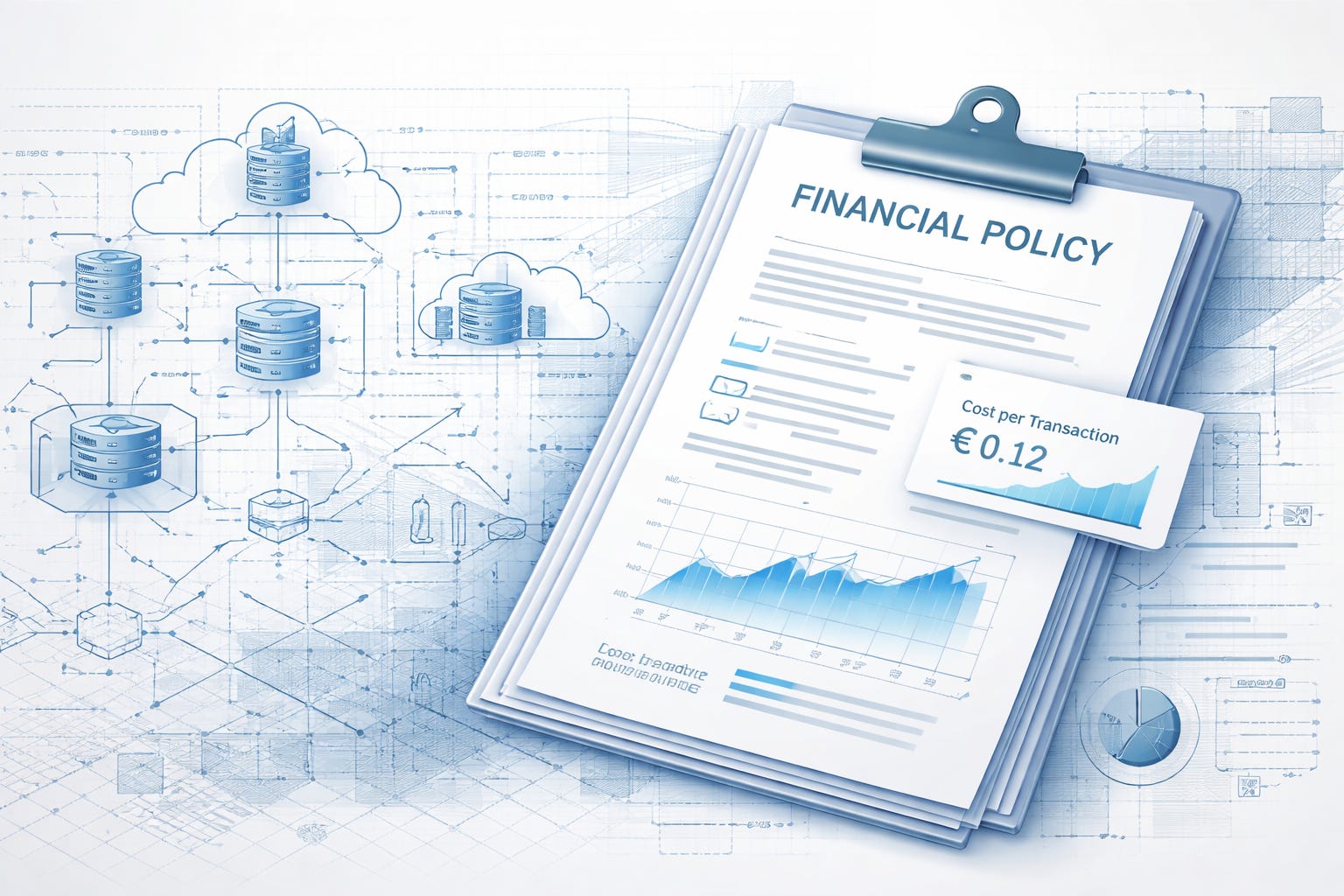
Why architecture functions as financial policy
Most organizations still operate with an on-prem mental model.
On-prem purchasing worked as an event: a contract, a signature, a checkpoint. Finance owned the purchase. Engineering owned the output. The procurement cycle created friction and, unintentionally, created governance.
Cloud removes the checkpoint. Engineers with deployment access can create ongoing liabilities in minutes. Autoscaling parameters, instance families, storage classes, streaming retention, “temporary” environments that stay alive—these choices produce recurring cost without anyone intending to “buy” anything.
This is the mechanism: purchasing moved into engineering workflows.
Financial policy follows the decision point, or it becomes commentary after the fact.
So the practical question becomes: where does your policy live?
infrastructure templates
deployment gates
tagging requirements enforced at creation
pre-approved patterns (“golden paths”)
budgets that trigger actions rather than emails
Monthly review cycles can still exist. They just stop being the primary control surface.
The predictable failure mode: savings that degrade output
Two structural issues show up again and again:
1) Reporting latency. Consumption changes daily; reviews happen monthly. By the time a report lands, the behavior already repeated.
2) Optimization without a value model. When the mandate becomes “reduce the bill,” teams comply. The bill drops. Reliability drops. Velocity drops. Customer experience metrics drift. Nobody ties the damage back to the “successful” savings initiative because the cost line and the product outcomes live in different rooms.
This is how organizations win the spreadsheet and lose the system.
Cloud spend needs an output model. Without one, every cost program turns into a cycle of cut → regret → re-spend.
The Decision Design Stack
Three components. Operational, measurable.
1) Attribution: ownership you can query
Tagging is your accountability data model. Treat it that way.
Minimum standard: a cost view by owner team/product/environment within 30 seconds. If that query takes a meeting, attribution is missing.
Implementation characteristics that actually work:
mandatory tags enforced at resource creation
ownership tied to teams, not individuals
mappings that mirror how the org ships (service, product surface, environment)
2) Feedback loops: cost meets the moment of choice
Cost signal belongs where change happens:
PR checks
deploy pipeline outputs
runbooks
post-deploy notifications
The timing matters. The same number lands differently when it appears during a deploy versus three weeks later in a review deck. Feedback loops compress decision latency.
Tie the signal to units, not totals. Totals invite debate. Units enable decisions.
3) Guardrails: defaults that preserve optionality
Guardrails are economic intent encoded into the system:
budgets with defined actions
expiry rules for non-production
pre-approved instance patterns
exception paths with fast approvals and clear ownership
This keeps speed intact because it removes ad-hoc decision making in the moment.
A useful mantra here: friction belongs on bad defaults, not on shipping.
Legacy vs Decision Design

From price to value: translate into units
This is the CFO–CTO handshake moment.
A €5,000/month data pipeline line item tells you very little on its own. It produces heat, not clarity.
Translate it:
€0.11 per active user
€18 per onboarded customer
€0.003 per processed transaction
Now you can choose deliberately:
invest if the unit economics support it
redesign if the unit is drifting
retire the workload if ROI is structurally negative
Finance protects value creation. Engineering makes value legible. Unit economics supplies a shared language that supports both roles without forcing either side into theatre.
The 48-hour install: five moves
No reorganisation is required. Instead install a small system that runs.
1) Choose one unit metric and place it beside every cost view.
Pick the unit closest to value: users, transactions, orders, seats. Automate the translation.
2) Start with showback.
Team-level visibility builds accountability without political debt. Incentives can come later.
3) Enforce a single guardrail for the repeat offenders.
Owner tag + budget threshold action + expiry for non-prod. One gate, applied consistently.
4) Put cost deltas into the workflow.
One integration. One signal. Delivered at deploy/PR time to the person who can act.
5) Run a weekly 30-minute decision log.
Three deltas. One decision per delta. One adjustment to guardrails or defaults. Keep it boring; consistency is the point.
A system that runs weekly qualifies as an operating model. Everything else qualifies as documentation.
Speed with control becomes the edge
Volatile conditions reward organizations that can move fast with explainable spend.
That capability depends on legibility:
spend tied to owners
spend tied to units
decisions made at the point of change
guardrails adjusted as reality changes
Architecture functions as financial policy either way. Deliberate design produces control. Default design produces surprises.
Aim for a bill you can defend. Size follows.
Questions I hear often:
We have a FinOps team. Why does this persist?
Because governance lives in the workflow. A FinOps function parked in reporting will generate visibility without leverage.
We’re early-stage. Does this matter yet?
Early is the cheapest moment to define ownership and units. Financial-architecture debt compounds in the same way technical debt does.
First fix?
Attribution. Ownership queries that resolve quickly change everything downstream.
If your current FinOps output ends in a deck, the organisation will keep paying for the same misunderstanding: visibility without leverage.
And I know I can help.
If you want a practical starting point for governing Cloud, SaaS, and AI spend, I packaged the templates, quickstart guide, and rollout plan into the FinOps Multiplier Toolkit.
See it here: https://www.strategicdepth.com/p/finops-multiplier-toolkit